
Canon AE-1 Program Camera Manual: A Comprehensive Guide
This guide delves into the Canon AE-1 Program, offering detailed instructions for enthusiasts and owners, a scanned 88-page PDF manual in English.
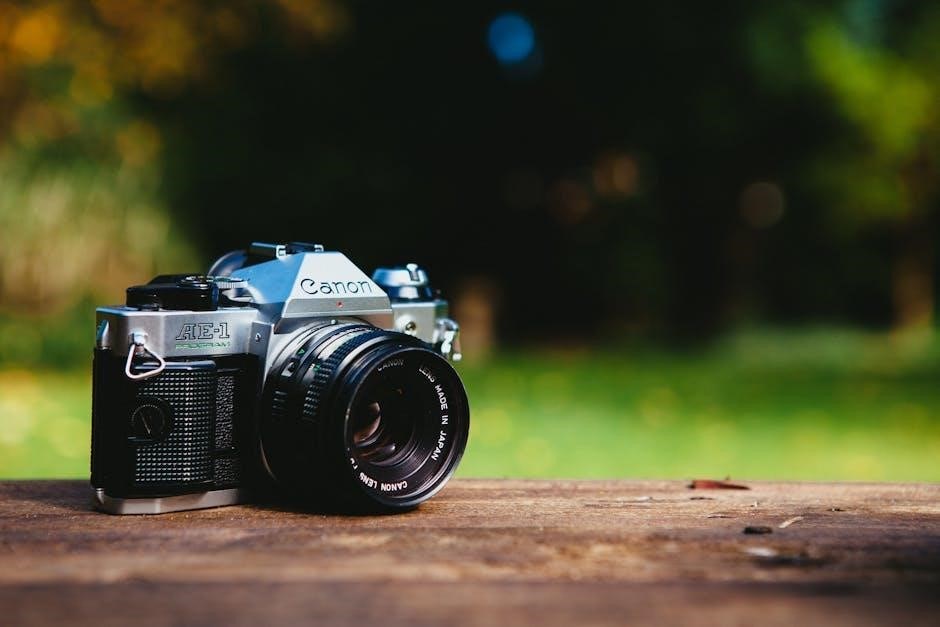
The Canon AE-1 Program, launched in 1981, quickly became a cornerstone for both amateur and professional photographers seeking a blend of accessibility and capability in a 35mm SLR. This camera isn’t merely a relic of the past; it remains remarkably relevant today, offering a tactile and engaging photographic experience.
Its enduring appeal stems from its innovative features, notably the Program mode – a groundbreaking automated exposure system for its time. This mode simplified photography, allowing users to concentrate on composition and capturing the moment. Beyond automation, the AE-1 Program offered full manual control, catering to experienced photographers who preferred a hands-on approach.
This guide aims to unlock the full potential of your Canon AE-1 Program, providing a comprehensive resource for mastering its functions and appreciating its unique character. Whether you’re a seasoned film shooter or a newcomer to analog photography, prepare to rediscover the joy of capturing images with this iconic camera.
Historical Context and Significance
The Canon AE-1 Program arrived during a pivotal shift in the photographic landscape of the early 1980s. It followed the success of the original AE-1, building upon its foundation with the addition of a fully programmed exposure mode. This innovation democratized photography, making precise exposure attainable for a wider audience without extensive technical knowledge.
Prior to the AE-1 Program, achieving correct exposure often required a deep understanding of the interplay between aperture, shutter speed, and ISO. The Program mode automated this process, allowing photographers to focus on creative aspects; The camera’s popularity helped solidify Canon’s position as a leading camera manufacturer, challenging established brands like Nikon.
Today, the AE-1 Program represents a significant chapter in photographic history, embodying a transition from fully manual operation to the convenience of automated systems. Its enduring legacy continues to inspire photographers seeking a connection to the roots of analog photography.
Key Features and Specifications
The Canon AE-1 Program is a 35mm film SLR renowned for its versatility. Key features include its Program mode for automated exposure, alongside shutter priority, aperture priority, and full manual control. It utilizes the Canon FD lens mount, compatible with a wide range of Canon FD lenses, such as the 50mm f/1.8 and 24mm f/2.8.
Specifications reveal a build combining plastic and metal, resulting in a weight of approximately 590g and dimensions of 141 x 87 x 48 mm. The camera incorporates a through-the-lens (TTL) metering system for accurate exposure readings. Focusing is achieved manually, aided by a split-image focusing aid in the viewfinder.
Its robust design and user-friendly operation made it a favorite among both amateur and professional photographers, cementing its place in photographic history.
Understanding the Camera Body
The AE-1 Program’s body blends plastic and metal, offering a solid feel, measuring 141 x 87 x 48 mm, and weighing 590g.
Build Quality and Dimensions
The Canon AE-1 Program showcases a robust construction, a thoughtful combination of durable plastic and metallic components. This design philosophy results in a camera that feels substantial in hand, inspiring confidence during use. Its dimensions are precisely 141 x 87 x 48 millimeters, making it comfortably sized—akin to a small book—for extended shooting sessions.
Despite its solid build, the AE-1 Program remains surprisingly lightweight, tipping the scales at just 590 grams. This manageable weight contributes to its portability, allowing photographers to easily carry it on various adventures. The camera’s build isn’t overly complex, prioritizing functionality and ease of use over excessive ornamentation, a hallmark of Canon’s pragmatic design approach during that era.
The Canon FD Lens Mount
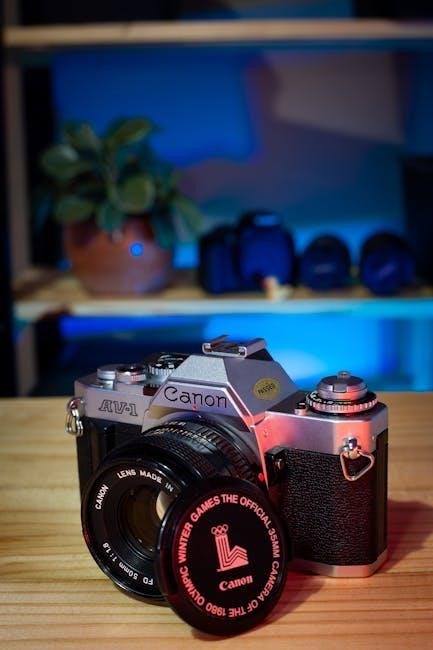
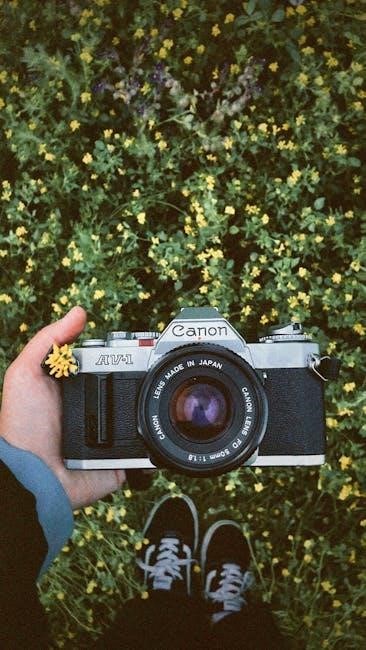
The Canon AE-1 Program utilizes the Canon FD lens mount, a defining characteristic that unlocks access to a diverse and highly regarded range of lenses. This mount system provides a secure and reliable connection between the camera body and various FD-series lenses. Photographers can explore options like the exceptionally sharp Canon FD 50mm f/1.8, a versatile standard lens, or the expansive FD 24mm f/2.8 for wider perspectives.
The FD mount is known for its mechanical operation and robust build quality. While it lacks the electronic communication found in modern lens mounts, it offers a direct and tactile shooting experience. Adapters are available, allowing the use of more contemporary lenses, but the native FD lenses truly complement the AE-1 Program’s classic appeal.
Viewfinder and Focusing Aids
The Canon AE-1 Program’s viewfinder provides a clear and bright view of the scene, essential for accurate composition and focusing. A key focusing aid is the split-image rangefinder located in the center of the viewfinder. This ingenious system divides the image into two parts; when perfectly in focus, these segments align, indicating sharp focus.
This manual focusing method requires practice, but it’s a rewarding experience, fostering a deeper connection between the photographer and the subject. The viewfinder also displays essential exposure information, guided by the camera’s TTL metering system. Mastering the split-image focusing is akin to playing a game – the reward is a beautifully sharp photograph.
Operational Modes and Settings
The Canon AE-1 Program offers versatile shooting modes: Program, Shutter Priority, Aperture Priority, and Manual, providing automated or full control over exposure.
Program Mode: Automated Exposure
Program Mode on the Canon AE-1 Program represents the camera’s fully automated setting, designed for simplicity and ease of use. In this mode, the camera intelligently selects both the shutter speed and aperture based on its through-the-lens (TTL) metering system, aiming for a properly exposed photograph. This is ideal for everyday shooting situations where quick results are desired without manual adjustments.
The camera evaluates the scene’s brightness and automatically chooses what it deems the optimal combination of settings. While convenient, it’s important to remember that the camera’s ‘intelligence’ isn’t infallible; understanding the limitations and potential for creative control in other modes is beneficial. Program mode prioritizes convenience, making it a great starting point for beginners exploring the Canon AE-1 Program’s capabilities.
Shutter Priority Mode (Tv)
Shutter Priority Mode (Tv) on the Canon AE-1 Program allows photographers to dictate the shutter speed while the camera automatically determines the appropriate aperture for correct exposure. This mode is particularly useful when capturing motion – either freezing it with a fast shutter speed or blurring it with a slower one. For example, sports photography benefits from rapid shutter speeds, while flowing water might require a slower setting.
The photographer retains creative control over motion depiction, while the camera handles the aperture adjustment to maintain proper brightness. Understanding the relationship between shutter speed, aperture, and exposure is crucial for effective use of Tv mode. It’s a powerful tool for achieving specific artistic effects and overcoming challenging lighting conditions.

Aperture Priority Mode (Av)
Aperture Priority Mode (Av) on the Canon AE-1 Program empowers photographers to select the desired aperture, influencing depth of field, while the camera automatically sets the shutter speed for correct exposure. A wider aperture (smaller f-number) creates a shallow depth of field, ideal for isolating subjects with blurred backgrounds – perfect for portraits. Conversely, a narrower aperture (larger f-number) yields greater depth of field, keeping more of the scene in focus, suitable for landscapes.
This mode prioritizes creative control over depth of field, letting the camera manage shutter speed to achieve proper brightness. Mastering Av mode requires understanding the interplay between aperture, shutter speed, and exposure, allowing for artistic expression and precise image control.
Manual Mode (M) – Full Control
Manual Mode (M) on the Canon AE-1 Program grants the photographer complete authority over both aperture and shutter speed, demanding a thorough understanding of the exposure triangle. This mode bypasses the camera’s automatic systems, requiring you to independently determine the correct settings for optimal exposure based on lighting conditions and desired creative effects.
Utilizing the TTL metering system as a guide, you manually adjust both settings until the light meter indicates proper exposure. Manual mode is invaluable for challenging lighting scenarios where automatic modes may struggle, offering precise control and fostering a deeper connection with the photographic process. It’s a cornerstone for learning photographic fundamentals.
Using the Canon AE-1 Program Effectively
Mastering the Canon AE-1 Program involves understanding its TTL metering, proper film loading, and ensuring correct battery function for optimal performance.
Through-the-Lens (TTL) Metering System
The Canon AE-1 Program boasts a sophisticated Through-the-Lens (TTL) metering system, a cornerstone of its user-friendly operation. This system continuously analyzes the light reflecting from the scene through the lens itself, providing remarkably accurate exposure readings. Unlike earlier systems that measured light before it passed through the lens, TTL metering accounts for the specific characteristics of the attached lens, ensuring precise results.
This means the camera assesses the light as it will be recorded on the film, compensating for factors like lens distortion and filter effects. The metering display within the viewfinder guides you to proper exposure, indicating whether the scene is underexposed, overexposed, or correctly exposed. Understanding this system is crucial for consistently achieving well-exposed photographs with the Canon AE-1 Program, allowing photographers to confidently capture their vision.
Film Loading and Rewinding
Loading film into the Canon AE-1 Program is a straightforward process, essential for capturing images. First, open the camera back using the film release lever. Place the 35mm film canister into the film chamber and pull the film leader across the camera body to the take-up spool. Ensure the film engages with the teeth of the spool. Close the camera back, advancing the film several times to ensure proper tension.
Rewinding the film requires pressing the film rewind button on the camera base. Then, use the rewind crank to smoothly retract the film back into the canister. Resist the urge to force the rewind; a gentle, consistent motion is key. Once the film is fully rewound, open the camera back and remove the canister. Proper loading and rewinding preserve your images!
Battery Information and Replacement
The Canon AE-1 Program utilizes a 4LR44 or equivalent 6V battery to power its electronic functions, including the light meter and shutter speed display. Battery life varies depending on usage, but regular checks are recommended. A weak battery can lead to inaccurate exposure readings or camera malfunction.
To replace the battery, open the battery compartment located on the camera’s bottom. Remove the old battery and insert a fresh one, ensuring correct polarity (+ and -). Close the compartment securely. Avoid mixing old and new batteries. Always dispose of used batteries responsibly, following local regulations. Maintaining a fresh battery ensures optimal camera performance and accurate metering.
Advanced Techniques and Troubleshooting
Master depth of field, exposure compensation, and resolve common issues with this section’s guidance for optimal Canon AE-1 Program performance.
Depth of Field Control
Understanding depth of field is crucial for creative control in your photography with the Canon AE-1 Program. It dictates how much of your image appears acceptably sharp. A larger aperture (smaller f-number like f/1.8) creates a shallow depth of field, ideal for isolating subjects with a blurred background – perfect for portraits. Conversely, a smaller aperture (larger f-number like f/16) yields a greater depth of field, keeping more of the scene in focus, suitable for landscapes.
The AE-1 Program allows manual aperture control, enabling you to precisely manage this effect. Experiment with different f-stops and focusing distances to see how they impact the sharpness throughout your image. Remember that focal length also plays a role; longer lenses generally produce shallower depth of field than wider lenses at the same aperture and distance. Mastering depth of field elevates your images, adding artistic flair and directing the viewer’s attention.
Exposure Compensation
Exposure compensation on the Canon AE-1 Program is vital when the camera’s metering system is fooled by challenging lighting situations. The camera attempts to render scenes as “average” gray, potentially underexposing bright subjects like snow or overexposing dark ones; This feature allows you to override the camera’s automatic exposure settings.
Using the exposure compensation dial, you can instruct the camera to increase or decrease the exposure. Positive compensation (+1, +2) brightens the image, useful for backlit scenes or dark subjects. Negative compensation (-1, -2) darkens the image, ideal for bright scenes or to prevent blown-out highlights. Practice and observation are key to understanding how much compensation is needed in various scenarios, ensuring properly exposed photographs.
Common Issues and Solutions
Common issues with the Canon AE-1 Program often involve the battery compartment, prone to corrosion from leaking batteries. Regularly inspect and clean the contacts. Another frequent problem is a stiff shutter button, often resolved with a careful cleaning and lubrication by a qualified technician. Light seals deteriorate over time, causing light leaks; replacement is necessary.
If the meter isn’t functioning, check the battery first. A faulty film advance mechanism might require professional repair. Sticky aperture blades can cause inaccurate exposures; avoid forcing them. Remember, attempting complex repairs yourself can cause further damage. Consulting a camera repair specialist is recommended for significant malfunctions, preserving the camera’s functionality.
Resources and Further Learning
Explore online communities and forums for Canon AE-1 Program support, plus readily available downloadable manuals for mastering this classic camera.
Availability of the Canon AE-1 Program Manual
Finding a Canon AE-1 Program manual today is surprisingly accessible, thanks to the digital age. While original printed copies can be located through vintage camera retailers or online auction sites, a high-quality, downloadable PDF version is readily available. Aesthetique offers a full, scanned version of the original 88-page manual, providing quick and easy access to detailed instructions.
This digital format eliminates the worry of damaging a fragile vintage document and allows for convenient viewing on various devices. The manual, available in English, covers all aspects of the camera’s operation, from basic film loading to advanced techniques. Several online resources also host scanned copies or links to download the manual, ensuring that this valuable guide remains accessible to photographers and enthusiasts alike.
Online Communities and Forums
For Canon AE-1 Program users, a wealth of knowledge exists within online communities and photography forums. These platforms offer a space to connect with fellow enthusiasts, share experiences, and troubleshoot issues. Dedicated forums often feature specific threads for the AE-1 Program, providing a focused resource for questions and advice.
Users frequently share tips on lens compatibility, repair solutions, and creative techniques. These communities are invaluable for learning beyond the manual, discovering hidden features, and gaining insights from experienced photographers. Websites like Reddit’s r/analog and dedicated film photography forums are excellent starting points for finding support and inspiration. Engaging with these communities enhances the ownership experience.