The Canon EOS 1300D is a fantastic entry point into DSLR photography, offering a blend of affordability and quality for beginners.
It’s designed for those transitioning from smartphones or compact cameras, seeking enhanced image capabilities and creative control.
This camera provides a solid foundation for learning photography, with user-friendly features and a lightweight design, making it accessible to all.
The 1300D closely resembles the 1200D in design, offering a familiar experience for those upgrading, while introducing new features.
With an 18.0 Megapixel sensor and built-in Wi-Fi, it delivers detailed images and easy sharing, making it a versatile choice for everyday photography.
What is the Canon EOS 1300D?
The Canon EOS 1300D, also known as the Rebel T6 in the US, is an entry-level DSLR camera designed to bridge the gap between smartphone photography and more serious image capture.
It features an 18.0 Megapixel APS-C CMOS sensor, delivering detailed images, and the DIGIC 4+ image processor for enhanced performance.
This camera is a compact, lightweight, and easy-to-operate DSLR, ideal for novice users seeking better image and movie quality than typical digicams offer.
Target Audience: Beginner Photographers
The Canon EOS 1300D is specifically tailored for individuals new to DSLR photography, offering a gentle learning curve and accessible features.
It’s perfect for those stepping up from smartphone cameras, desiring greater control over image quality and creative expression.
This camera suits anyone wanting a user-friendly introduction to interchangeable lens photography, without overwhelming complexity.
Key Features and Specifications
The Canon EOS 1300D boasts an 18.0 Megapixel APS-C sensor, DIGIC 4+ processor, and a 9-point autofocus system for sharp, detailed images.
Built-in Wi-Fi simplifies image transfer and sharing, enhancing the overall user experience.
18.0 Megapixel APS-C CMOS Sensor
The Canon EOS 1300D utilizes an 18.0-megapixel APS-C CMOS sensor, delivering a balance between resolution and image quality. This sensor size is larger than those found in most smartphones and compact cameras.
It captures detailed images with good low-light performance, allowing for creative flexibility. The sensor works in tandem with the DIGIC 4+ image processor to produce clear and vibrant photographs.
This combination provides a solid foundation for both beginners and those looking to upgrade their photography.
DIGIC 4+ Image Processor
The Canon EOS 1300D is powered by the DIGIC 4+ image processor, which plays a crucial role in image quality and overall camera performance. This processor efficiently handles image processing tasks, resulting in reduced noise and improved color reproduction.
It enables fast operation and responsiveness, enhancing the shooting experience. The DIGIC 4+ also contributes to the camera’s ability to capture detailed 1080p Full HD video.
9-Point Autofocus System
The Canon EOS 1300D features a 9-point autofocus (AF) system, enabling accurate and reliable subject tracking. This system utilizes nine AF points strategically positioned across the frame, allowing for flexible composition and focusing options.
It’s suitable for capturing moving subjects and ensuring sharp images in various shooting scenarios, providing a solid foundation for beginner photographers.
Camera Body and Design
The Canon EOS 1300D boasts a compact and lightweight body, closely mirroring the 1200D’s design. It’s comfortable to hold, measuring 129mm wide and 101.3mm tall.
This DSLR is designed for ease of use, making it ideal for novice photographers.
Physical Dimensions and Weight
The Canon EOS 1300D measures approximately 129mm (W) x 101.3mm (H) x 77.8mm (D), making it relatively compact for a DSLR.
Its lightweight design contributes to comfortable handling during extended shooting sessions.
The camera body weighs around 485g (body only) and 505g with the battery and memory card installed. This makes it easily portable for travel and everyday use.
These dimensions and weight make it accessible for beginner photographers.
Button and Control Layout
The Canon EOS 1300D features a straightforward button and control layout, prioritizing ease of use for beginners.
Control placement is nearly identical to the 1200D, offering familiarity for upgraders.
Essential controls, like the shutter button, mode dial, and directional buttons, are readily accessible. The rear panel houses buttons for menu navigation, image playback, and Live View shooting.
This intuitive design simplifies operation.
Build Quality and Materials
The Canon EOS 1300D boasts a compact and lightweight build, making it comfortable to handle for extended periods.
While primarily constructed from plastic, the camera feels reasonably sturdy for its price point.
Its dimensions are 129mm wide, 101.3mm high, and 77.6mm deep, contributing to its portability.
Though not weather-sealed, it’s a practical choice for everyday photography.
Connectivity and Wireless Features
The Canon EOS 1300D features built-in Wi-Fi, enabling seamless image transfer to smartphones and tablets via the Canon Camera Connect App.
This simplifies sharing photos and remote camera control.
Built-in Wi-Fi for Image Transfer
The EOS 1300D’s integrated Wi-Fi functionality streamlines image sharing. Easily transfer photos and videos wirelessly to your smartphone or tablet for quick posting to social media or backing up your memories.
This feature eliminates the need for cables or card readers, offering a convenient and modern workflow. Connecting is simple, allowing for immediate sharing of your photographic creations.
It’s a key feature for those who want to stay connected and share their images on the go.
Canon Camera Connect App Compatibility
The Canon Camera Connect app enhances the EOS 1300D’s wireless capabilities. This app, available for iOS and Android, allows for remote camera control, including live view monitoring and shutter release.
You can also browse and download images directly to your smartphone, simplifying image management. Furthermore, the app facilitates easy sharing to various social media platforms and cloud services.
It’s a powerful tool for photographers seeking greater control and convenience.
Shooting Modes and Settings
The EOS 1300D offers a range of shooting modes, from fully automatic for beginners to manual for experienced users, providing creative flexibility.
Scene modes like Portrait, Landscape, and Sports optimize settings for specific situations, ensuring great results.
Auto Mode for Beginners
Auto mode simplifies photography for newcomers, letting the camera handle all settings – aperture, shutter speed, ISO, and white balance.
This is ideal for point-and-shoot simplicity, ensuring well-exposed photos in various conditions without needing technical knowledge.
It’s a great starting point to learn composition and framing, while the camera optimizes image quality automatically, delivering consistent results.
Focus and capture moments effortlessly!
Scene Modes (Portrait, Landscape, Sports, etc.)
Scene Modes offer pre-set configurations for specific shooting situations, enhancing image quality with a single selection.
Options like Portrait prioritize subject clarity with blurred backgrounds, while Landscape optimizes for sharp details and vibrant colors.
Sports mode freezes action, and Night mode captures low-light scenes effectively, simplifying complex settings for beginners.
Experiment with these modes to achieve professional-looking results easily!
Manual Mode for Full Control
Manual Mode (M) unlocks complete creative control over aperture, shutter speed, and ISO, allowing photographers to fine-tune exposure;
This mode is ideal for learning photographic principles and achieving specific artistic visions, though it requires a deeper understanding of camera settings.
Mastering Manual Mode empowers you to capture images precisely as you envision them, beyond automated assistance.
It’s a powerful tool for experienced users!
Lenses and Compatibility
The Canon EOS 1300D utilizes the Canon EF and EF-S lens mount, offering a vast selection of compatible lenses.
This system provides flexibility for various photographic styles and budgets.
Explore options from Canon and third-party manufacturers!
Canon EF and EF-S Lens Mount
The Canon EOS 1300D features the widely-used Canon EF and EF-S lens mount, a significant advantage for photographers. This compatibility unlocks access to a massive ecosystem of lenses, both new and used, from Canon and numerous third-party manufacturers.
EF lenses offer full-frame coverage, while EF-S lenses are designed specifically for APS-C sensors like the 1300D’s, providing a more compact and affordable option.
This mount ensures versatility and future-proofing for your photographic journey.
Recommended Lenses for the EOS 1300D
For versatile shooting, the Canon EF-S 18-55mm kit lens is an excellent starting point. To expand reach, consider the Canon EF 70-300mm f/4-5.6 IS II USM for wildlife or sports.
Portrait photographers might enjoy the Canon EF 50mm f/1.8 STM, offering beautiful bokeh.
The EF-S 18-135mm provides a wider zoom range for travel and everyday use, offering great value.

Image and Video Quality
The EOS 1300D captures detailed 18.0 Megapixel images, and offers 1080p video recording.
ISO performance is acceptable at lower settings, but noise becomes noticeable at higher ISO values.
Overall, image quality is good for beginners and casual photographers.
ISO Performance and Noise Levels
The Canon EOS 1300D’s ISO performance is generally good for an entry-level DSLR. Images taken at lower ISO settings (100-400) exhibit minimal noise and retain excellent detail. As ISO increases, noise becomes more apparent, particularly from ISO 800 onwards.
While usable images can be obtained at higher ISOs (1600-3200), some loss of detail and increased noise are noticeable. Careful post-processing can mitigate these effects, but it’s best to keep ISO as low as possible for optimal image quality.
Video Recording Capabilities (1080p)
The Canon EOS 1300D is capable of recording Full HD 1080p video at 24, 25, and 30 frames per second, offering a decent level of detail for basic video projects. While it doesn’t feature advanced video specifications like 4K recording, it’s sufficient for casual use.
Video quality is acceptable in good lighting conditions, but can suffer in low light due to increased noise. The camera lacks a headphone jack for audio monitoring during recording.
Using the Canon EOS 1300D
Powering on the EOS 1300D is straightforward, and navigating the menu system is relatively intuitive, even for beginners.
Taking your first photos involves selecting a shooting mode and utilizing the shutter button for capturing images.
Powering On and Basic Operations
To power on the Canon EOS 1300D, locate the main power switch, typically around the shutter button. Ensure a charged battery and inserted memory card are present. The camera will initialize, displaying the shooting screen.
Basic operations include setting the mode dial to ‘Auto’ for simplified shooting or exploring ‘Scene’ modes. Use the shutter button to focus and capture images. Review photos on the LCD screen.
Familiarize yourself with the directional buttons for menu navigation and settings adjustments.
Navigating the Menu System
Accessing the menu on the Canon EOS 1300D is done via the ‘Menu’ button. The menu is divided into several tabs, represented by icons: shooting, playback, setup, and more.
Use the directional buttons to highlight desired options and press ‘Set’ to confirm.
Explore settings for image quality, autofocus, ISO, and white balance; The menu structure is logical, allowing for customization of camera functions.
Taking Your First Photos
To begin, ensure a charged battery and a formatted memory card are installed. Set the mode dial to ‘Auto’ for simplicity. Compose your shot using the viewfinder or Live View screen.
Half-press the shutter button to activate autofocus, and fully press to capture the image.
Review your photos using the playback button, adjusting settings as needed for optimal results.
Troubleshooting Common Issues
Common problems include autofocus errors, poor image quality, and Wi-Fi connectivity issues. Refer to the manual for solutions, checking settings and lens compatibility.
Restarting the camera often resolves minor glitches, ensuring optimal performance.
Autofocus Problems
If autofocus isn’t working, ensure the lens is properly attached and set to autofocus (AF) mode, not manual (MF). Verify sufficient light, as low light can hinder performance.
Select an appropriate autofocus point or zone in the viewfinder; Clean the autofocus points on the lens and camera body. Try a different lens to isolate the issue.
Consult the manual for specific autofocus settings and troubleshooting steps related to various shooting scenarios.
Image Quality Concerns
For blurry images, check shutter speed – ensure it’s fast enough to avoid motion blur, especially in low light. Increase ISO cautiously, as higher settings introduce noise.
Review aperture settings for desired depth of field. Confirm proper focusing technique and utilize the viewfinder for precise alignment. Adjust white balance for accurate colors.
Refer to the manual for optimal settings based on shooting conditions and explore picture style options for customized image profiles.
Connectivity Issues
If Wi-Fi connection fails, verify the correct password and ensure your smartphone is compatible with the Canon Camera Connect app. Restart both the camera and your mobile device.
Check Wi-Fi settings within the camera’s menu, confirming it’s enabled and searching for available networks. Update the app to the latest version. Refer to the manual for detailed pairing instructions.
Ensure Bluetooth is enabled if using that connection method for initial setup.
Accessories and Optional Equipment
Essential accessories include a compatible battery and charger, plus a reliable SD memory card for storing photos and videos.
A camera bag and comfortable strap enhance portability and ease of use during your photographic adventures.
Battery and Charger
The Canon EOS 1300D typically utilizes the Canon LP-E10 battery, providing sufficient power for a reasonable number of shots per charge.
A dedicated LC-E10 charger is included, allowing for convenient recharging when the battery is depleted.
Consider purchasing an additional battery for extended shooting sessions, especially when Wi-Fi is frequently used, as it can impact battery life. Proper battery care extends its lifespan.
Memory Cards
The Canon EOS 1300D supports SD, SDHC, and SDXC memory cards for storing photos and videos.
A card with ample storage capacity is recommended, especially for 1080p video recording.
Faster cards (UHS Speed Class 3) are beneficial for continuous shooting and high-resolution video, ensuring smooth performance and minimizing buffering delays during crucial moments.
Camera Bag and Straps
Protecting your Canon EOS 1300D requires a suitable camera bag. Choose one with padded compartments to safeguard the body and lenses from impacts during transport.
A comfortable camera strap is essential for secure handling while shooting. Consider a padded strap to reduce neck strain during extended use.
Additional straps can offer enhanced security and comfort.
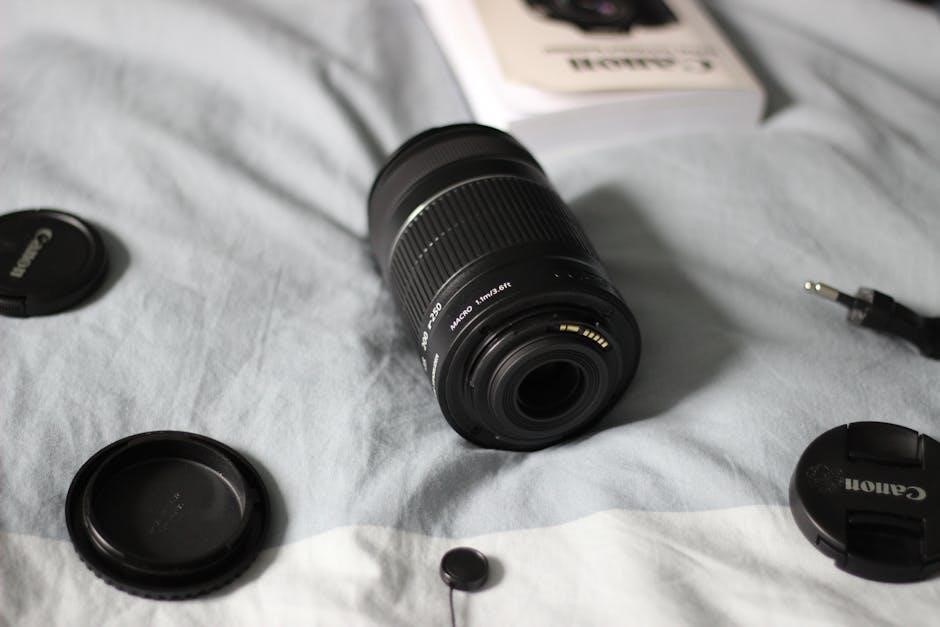
Price and Availability
The Canon EOS 1300D is known for its reasonable price point, typically around $299 for the body alone.
Availability varies, but it’s widely stocked at major electronics retailers and online marketplaces.
Current Market Price
As of today, December 22, 2025, the Canon EOS 1300D body typically retails for approximately $350 ─ $400 USD.
Kit options, including an 18-55mm lens, generally range from $450 to $550. Prices fluctuate based on retailer promotions and availability.
Used models can be found for significantly less, often around $200-$300, depending on condition and included accessories.
Where to Purchase the EOS 1300D
The Canon EOS 1300D is widely available through major electronics retailers like Best Buy, Amazon, and Walmart.
Canon’s official online store also offers direct purchases, often with bundled accessories. Local camera shops provide expert advice and potential package deals.
Checking for refurbished options on Canon’s website or reputable resellers can offer cost savings.
Comparison with Similar Models
Compared to the EOS 1200D, the 1300D offers upgraded features like built-in Wi-Fi and improved image processing.
The EOS 2000D provides a more modern processor and slightly enhanced features, but at a higher price point.
Canon EOS 1200D
The Canon EOS 1200D, the predecessor to the 1300D, shares a similar 18.0 Megapixel APS-C CMOS sensor, providing comparable image quality. However, it lacks the 1300D’s integrated Wi-Fi connectivity, requiring a separate adapter for wireless image transfer.
Its control layout is nearly identical, offering a familiar experience, but the 1300D benefits from a refined image processor for slightly improved performance.
Canon EOS 2000D
The Canon EOS 2000D (Rebel T7) represents a step up from the 1300D, featuring a slightly more advanced DIGIC 4+ processor and improved autofocus performance. While both cameras are entry-level DSLRs, the 2000D offers enhanced video capabilities and a more refined user interface.
However, the 1300D remains a compelling option due to its compact size and affordability.
Advanced Features
Creative Filters offer artistic expression directly in-camera, while Basic+ Mode simplifies complex settings for beginners, enhancing usability and creative control.
These features expand photographic possibilities beyond automatic settings.
Creative Filters
The Canon EOS 1300D boasts a selection of Creative Filters, allowing photographers to instantly add unique effects to their images directly within the camera.
These filters include options like Fish-eye, Grainy Black & White, Soft Focus, and Toy Camera, providing artistic styles without post-processing.
Experimenting with these filters encourages creative exploration and offers a quick way to personalize photos, adding a distinctive touch to everyday shots.
Basic+ Mode
Basic+ Mode on the Canon EOS 1300D simplifies camera settings while still offering creative control. It allows users to adjust background blur, brightness, and white balance easily.
This mode provides helpful on-screen guidance, making it ideal for beginners wanting to move beyond fully automatic shooting without being overwhelmed by manual settings.
It’s a stepping stone towards mastering more advanced photographic techniques, fostering a deeper understanding of exposure and composition.
Maintenance and Care
Regular cleaning of the sensor and proper battery care are crucial for maintaining the Canon EOS 1300D’s performance and longevity.
Protecting your investment ensures consistent image quality and reliable operation for years to come.
Cleaning the Sensor
Dust on the sensor can appear as spots in your images. Canon recommends using a blower to remove loose particles first. If needed, utilize a sensor cleaning kit – swabs and fluid – with extreme care.
Always follow the kit’s instructions precisely to avoid damaging the delicate sensor. Consider professional cleaning if you’re uncomfortable performing this task yourself, ensuring optimal image clarity.
Battery Care
To maximize battery life, fully charge the battery before first use. Avoid extreme temperatures, as heat and cold can reduce performance. Store the battery in a cool, dry place when not in use.
Only use Canon-approved chargers to prevent damage. Don’t leave a fully charged battery unused for extended periods, as this can degrade its capacity over time.